
Making Got Easy. What Should Junior Designers and Developers Do Now?
AI made design and development easier, and the first rung of the career ladder harder. What the data says, why your own tool is rarely a plan B, and what works instead.
 Written byMatt Gemi, Founder, Urest
On this page
AI has made it easier than ever to design a screen or ship working code, and that has quietly moved the value in our industry. Experienced designers and developers are raising their prices and delivering faster. The squeeze lands on people earlier in their careers, where entry-level hiring has fallen sharply. The way through is not to out-produce AI, but to get good at what it still does badly: judgment, taste, context and finishing work that holds up.
Not long ago, design and development were scarce skills. A good designer was easy to tell from a weak one, and a developer could turn an idea into a product while everyone else stayed at the idea stage. That gap is closing. AI is not as creative as a strong designer yet, and it is not a great developer in every language, but it gets better every month. Today almost anyone with an idea can build a first version of it.
So the real question is no longer who can make things. It is who can make something worth having in the middle of a production flood.
Has AI really made design and development easier?
Yes, for producing a first version. Tools that generate layouts, components and code have cut the cost of getting from an idea to something on a screen. The catch is quality. In the Stack Overflow Developer Survey 2025, 84% of developers said they use or plan to use AI tools, but only about a third trusted the accuracy of what those tools produce. The most common frustration was answers that are almost right, but not quite.
That gap between almost right and right is where the work now sits. Nielsen Norman Group's State of UX 2026 puts it plainly for design: interface output is getting cheaper to produce, while taste, research-grounded context and judgment are what resist automation.
What are experienced designers and developers doing about it?
They are charging more and delivering faster. Senior people use AI to remove the slow, repetitive parts of a project, which shortens delivery without lowering the standard, and they put a higher price on the judgment that makes a project work. Clients notice the speed: in 20i's 2026 survey of 500 US web designers (20i is a hosting company), 75% said AI-driven competition had affected their business, and clients ranked delivery speed and price above visual appeal.
We have seen the same shift in our own studio. We built AI into how we work, and it has been a clear positive: work that used to take a month now takes a few days, and because each round is faster we can explore more alternatives before choosing one, without lowering the bar on quality. Experience is what makes that possible. Knowing which output to keep and which to throw away is most of the job.
Why is it harder for junior designers and developers right now?
Because the first rung of the ladder is the work AI does most easily, and companies are hiring fewer people to do it.
We see it close to home, not only in reports. Several graphic designers we know, salaried nine to five in-house at small companies, have lost their jobs over the past year. They were the one designer a business relied on for social posts, flyers and banners, and that work has gradually moved to AI tools the owner can run themselves.
- A Stanford Digital Economy Lab study, Canaries in the Coal Mine? (revised August 2026), found that employment of 22 to 25 year olds in the most AI-exposed occupations is 19% below where it would be had it kept pace with less exposed peers.
- In US software development job postings, Indeed Hiring Lab counted 69.3% senior roles and just 4.5% entry-level ones in early 2026, the lowest entry-level share of any sector it tracks.
- SignalFire's State of Tech Talent report found new graduates made up 7% of Big Tech hires, down more than half since 2019, and described an experience paradox: junior roles posted, then filled by seniors.
- In design, Nielsen Norman Group reports that UX hiring is stabilising, but senior and generalist roles are recovering faster, while entry-level positions remain scarce.
None of this means the ladder is gone. It means the first rung moved up. Work that used to train a junior (production design, simple pages, routine code) is now partly done by tools, so a junior has to arrive closer to the second rung.
Is building your own tool a good plan B?
As an experiment, yes. As a plan B you count on, usually not. The same tools that make building easy make it easy for everyone, so the number of products has exploded while the number of buyers has not.
Product Hunt's State of Tech Discovery for Q2 2026 counted 2,345 launches in the quarter, up from 1,508 a year earlier, with most AI builders launching for the first time. On the money side, RevenueCat's State of Subscription Apps 2026, as reported by 9to5Mac, found that only 17% of new subscription apps passed $1,000 in monthly revenue in 2025.
Building is no longer the hard part. Distribution, trust and knowing a problem better than anyone else are. If you want to build a product, start from a niche you already understand or an audience you already have, and treat the first version as a test you are prepared to stop.
What should junior designers do now?
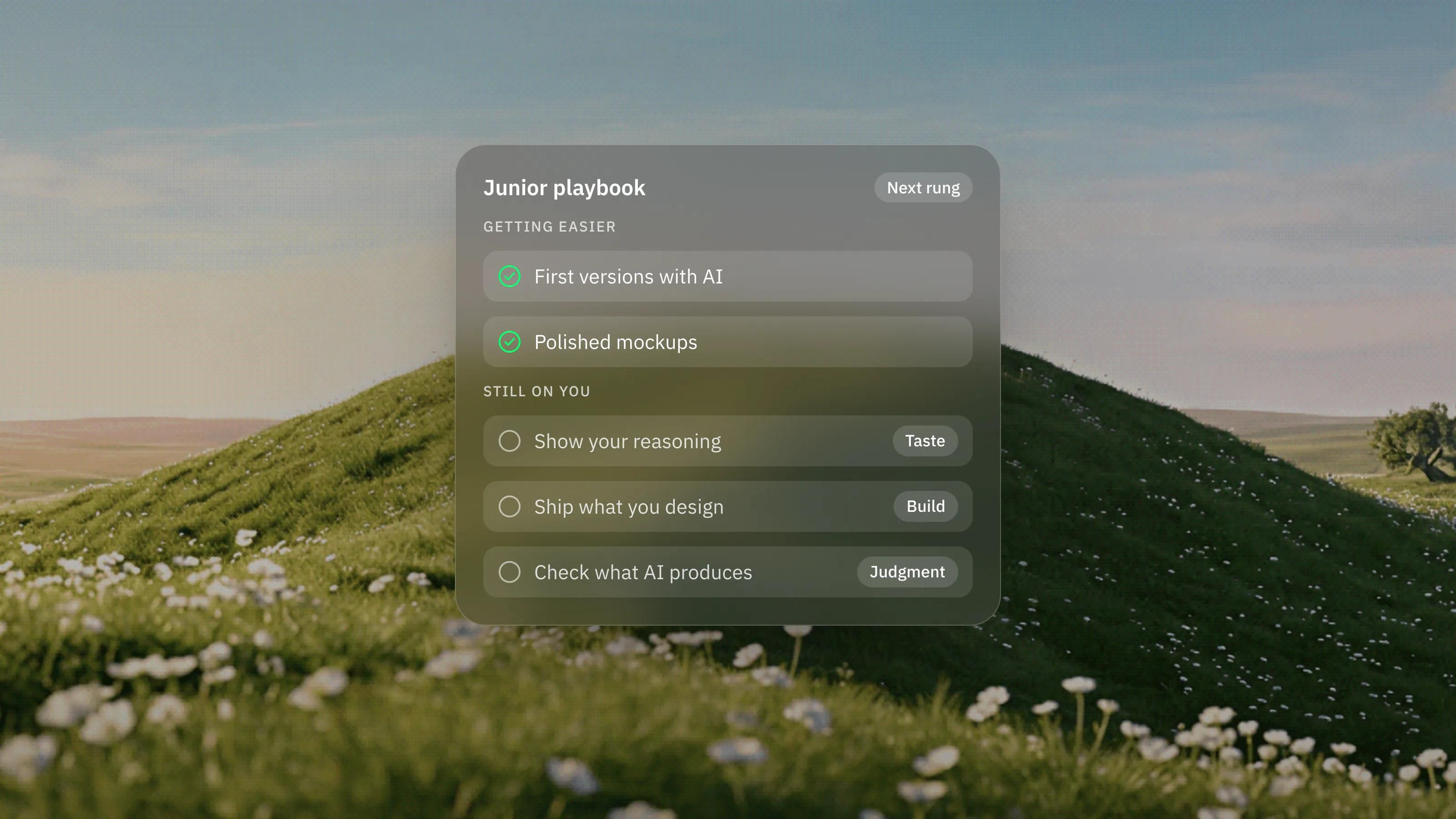
Become the designer who can explain why, and ship what they design.
- Show your thinking, not only your screens. Anyone can now produce a polished mockup. A portfolio that shows the problem, the options you rejected and why you chose one is far harder to fake.
- Learn to build. Designers who can take a design live in a tool like Framer or Webflow, or work in code, sit where demand is growing. A design that ships beats a design that waits for a developer.
- Use AI to explore, then edit hard. Generate ten directions in the time one used to take, then do the part AI cannot: pick the right one and make it good.
- If you are in-house, move closer to the business. The designer who only produces assets is the easiest role for a small company to replace. The one who runs the brand, plans the campaigns and knows which posts actually bring in customers is much harder to let go.
- Go deep on one kind of client. Knowing how an interior design studio, a clinic or a SaaS product actually wins customers makes your work specific, and specific work is hard to replace.
What should junior developers do now?
Become the developer who can be trusted with the result, not just the code.
- Get fluent with AI tools, and better at checking them. Using them is now the baseline. Reading, testing and fixing what they produce is the skill that separates you.
- Own outcomes, not tickets. Performance, accessibility, security and a site that still works after launch are where AI output most often falls short, and where clients notice.
- Move up the complexity curve. Do not compete on price for simple, repetitive work. Integrations, data, systems and the parts that break are where judgment is paid for.
- Learn enough design to have taste. A developer who can tell when something looks wrong ships fewer things that need to be redone.
What will actually be valuable in the production flood?
Judgment, taste and follow-through. When anyone can produce a first version, the scarce things are knowing what is worth making, making it well, and taking responsibility for it working. Those are built through experience, which is exactly why the start of a career is harder now and why it is still worth starting.
The designers and developers who do well over the next few years will not be the fastest producers. They will be the people others trust to decide what gets made, and to finish it properly.
Frequently asked questions
Will AI replace junior designers and developers?
AI is replacing a share of the routine work juniors used to start with, and entry-level hiring has fallen as a result. It is not replacing the need for people who can judge, edit and take responsibility for work. Juniors who build those skills early still have a path in, but it starts higher than it used to.
Are experienced designers and developers still in demand?
Yes. Job data from Indeed shows senior postings rising while entry-level postings fall, and Nielsen Norman Group reports senior and generalist UX roles recovering first. Experienced people are using AI to deliver faster and are charging for their judgment rather than their hours.
Is building a SaaS or tool a good backup plan for a designer or developer?
It works best as an experiment rather than a safety net. Product launches have surged as AI tools made building easier, while only a small share of new subscription apps reach meaningful revenue. Start from a problem or an audience you already know, because distribution is now harder than building.
What skills should a junior designer or developer learn first?
Learn to ship and learn to judge. For designers that means building in a tool like Framer or in code, and showing your reasoning in your portfolio. For developers it means using AI tools fluently while getting very good at testing and fixing what they produce.
Sources
The figures in this guide come from these reports and surveys, checked in November 2026.
- Stanford Digital Economy Lab, Canaries in the Coal Mine? Six Facts about the Recent Employment Effects of Artificial Intelligence (revised August 2026)
- Indeed Hiring Lab, The Labor Market Is Tilting Toward Seniority (July 2026)
- SignalFire, State of Tech Talent Report 2025 (May 2025)
- Nielsen Norman Group, State of UX 2026 (January 2026)
- Stack Overflow, Developer Survey 2025: AI (July 2025)
- 20i, 2026 Web Designer Survey (March 2026)
- Product Hunt, State of Tech Discovery, Q2 2026 (August 2026)
- 9to5Mac, Report on RevenueCat's State of Subscription Apps 2026 (March 2026)