Skip to content
Brand identity, mascot and motion (concept)

levvy: a mascot-led brand for a sourdough starter app

Self-initiated concept, not a client project
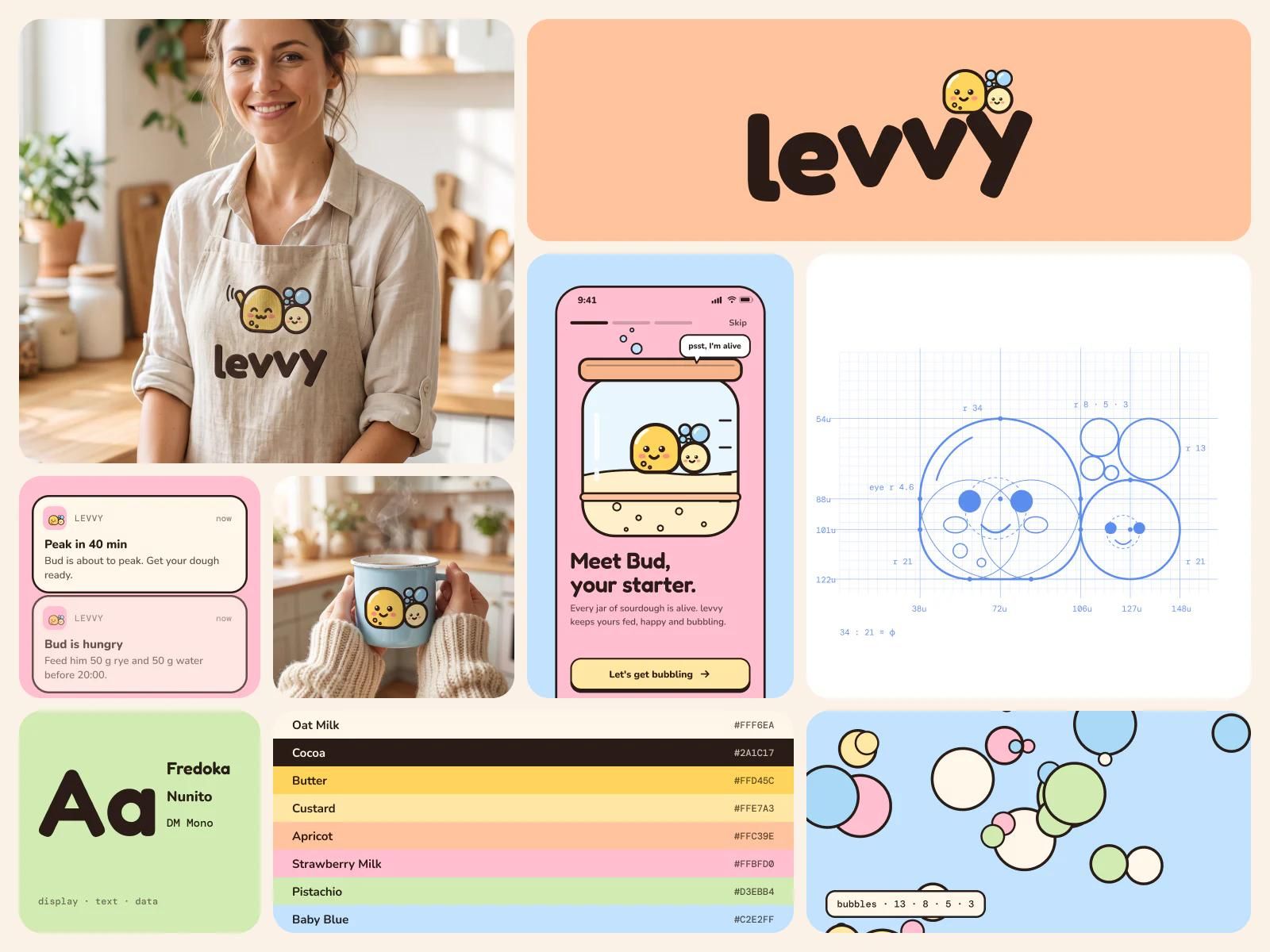
levvy Daylight board: a home baker in a levvy apron, Bud perched on the wordmark, the app, the construction drawing and the palette

The brief

levvy

levvy is a self-initiated concept. We set ourselves the brief we often get from founders: build a mascot-led identity from the first idea to motion, complete enough to launch with. A name, a character and its construction, a logo system, colour and type, app screens, merch and looping motion, all made in one day.

At a glance

Timeline
One day

Timeline

How the day ran.

From the first idea to motion, in one day.

Idea and name

Bud

Construction

Logo and lockups

Colour and type

Expressions and app screens

Merch

Motion

Urest

Point at a stage, or tap it, to see what happened.

  1. Idea and name

    • Urest: Your starter, kept alivelevvy, from levain, the French word for a sourdough starter, and the one-line idea.
  2. Bud

    • Urest: A budding yeast cellThe first dough sketch was dropped; Bud became a yeast cell with his baby bud.
  3. Construction

    • Urest: Fibonacci circlesGrid and guides, Fibonacci circles, the outline, then Bud.
  4. Logo and lockups

    • Urest: A rising wordmarkWordmark, horizontal and stacked lockups, the icon mark and lockup variants.
  5. Colour and type

    • Urest: Eight colours, three facesEight soft colours named after a morning kitchen; Fredoka, Nunito and DM Mono.
  6. Expressions and app screens

    • Urest: Eight states, three screensEight expressions mapped to the states of a starter, and three onboarding screens.
  7. Merch

    • Urest: Five lifestyle mockupsAn apron, the app on a phone, an enamel mug, laptop stickers and a canvas tote.
  8. Motion

    • Urest: Four loopsDaylight, Kitchen, Candy and Lockups: seamless 16-second boards, silent and with sound.

01

Summary

levvy is a brand we invented for a small app that keeps sourdough starters alive. The identity is led by Bud, a yeast cell drawn entirely from circles, who lives in the user's jar and tells them when he is hungry. We built the full system: name, mascot and its construction, logo lockups, colour and type, three app screens, lifestyle merch, and a set of looping motion boards with their own motion language.

02

What is levvy?

levvy is a concept for a sourdough starter coach. It reminds you when to feed your starter, tracks how much it rises after each feed, and tells you when it is about to peak, which is the best moment to bake. The name comes from levain, the French word for a sourdough starter, and it sounds like levity, the lightness a good starter gives bread.

The one-line idea: Your starter, kept alive.
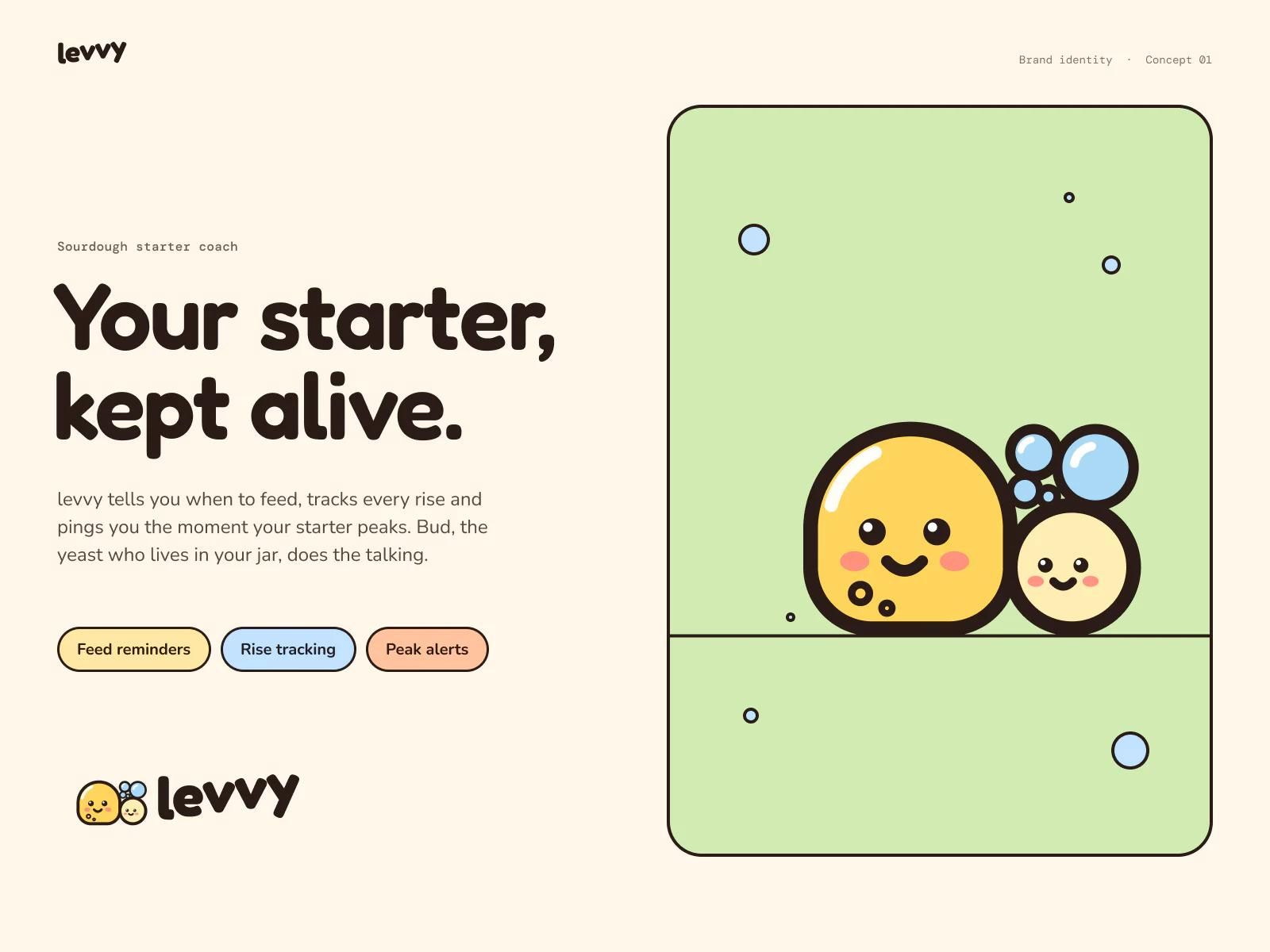
levvy cover: "Your starter, kept alive." next to Bud on a pistachio card

03

Why build a brand around a mascot?

A starter is not an ingredient, it is a living culture of wild yeast and bacteria. Bakers name their starters, carry them between homes and feel guilty when they forget to feed them. Most apps in this space treat the starter as data: a timer, a log, a chart. We wanted the opposite. If the starter has a face, a missed feed stops being a missed notification and becomes a hungry friend in a jar. That is a reason to open the app.

So the brand question became: what does the culture inside the jar look like?
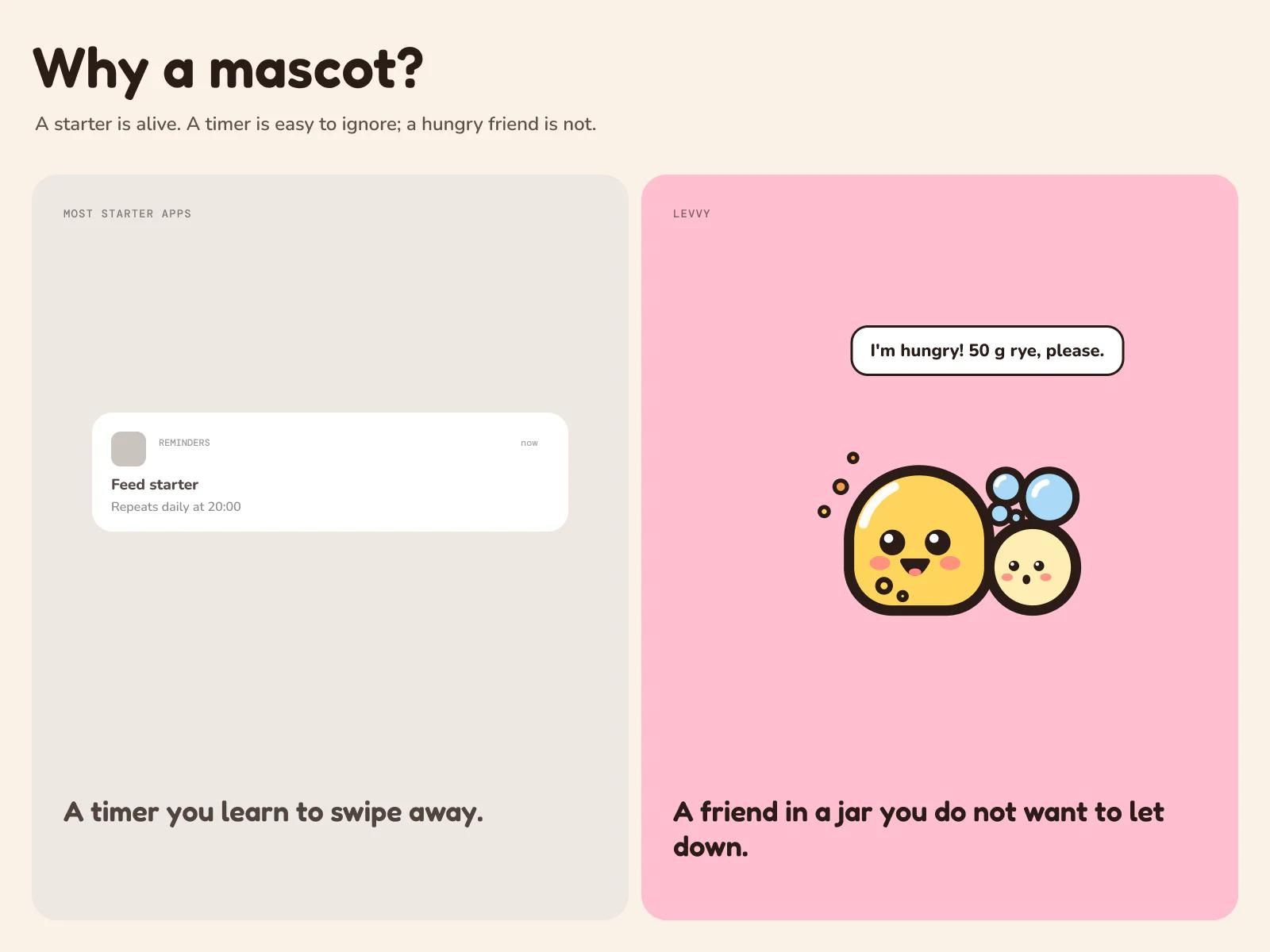
Why a mascot: a grey timer notification you swipe away next to Bud saying he is hungry

04

The challenge

01 A full brand in one day

Name, mascot, logo system, palette, type, app screens, merch and motion, finished in a single day.

02 A mascot that could only be levvy's

Our first sketch, a lump of dough with drips and round hands, looked like half the cute mascots online. We went back to the biology instead.

03 Turn data into a friend

Most starter apps treat the starter as a timer and a chart. The brand had to make a missed feed feel like a hungry friend in a jar.

04 Motion that loops cleanly

Every board had to close its loop without a jump.

05

Who is Bud?

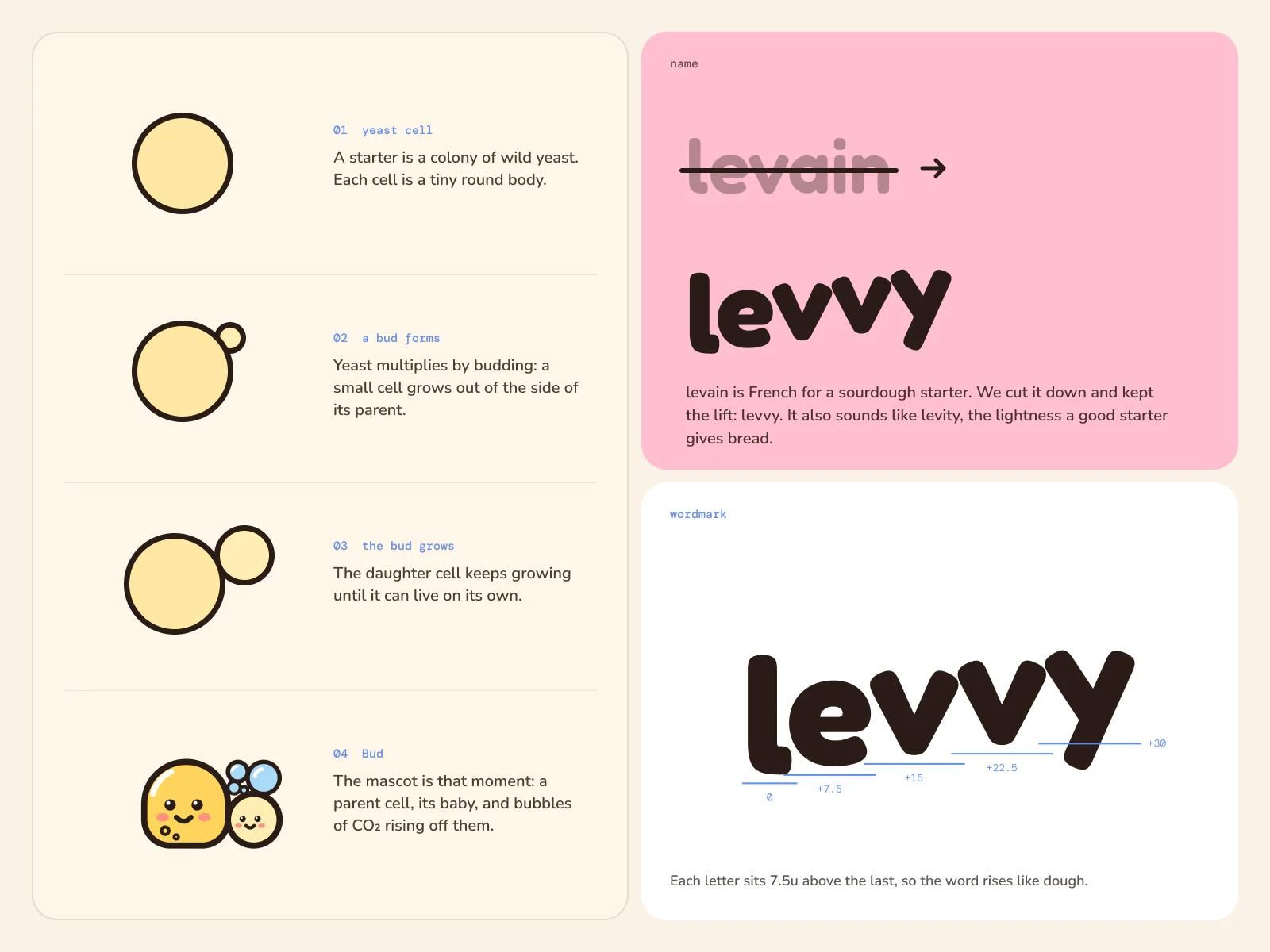
Bud is a yeast cell. Yeast reproduces by budding: a small daughter cell grows out of the side of the parent until it separates. That biology gave us the character. Bud always comes with his baby bud beside him, and a trail of bubbles rising off them, the carbon dioxide that makes dough rise.

His body is soft and squat, closer to a piece of mochi or a ball of dough than to a ghost or a blob. He sits flat on the ground line, because a starter sits at the bottom of a jar.

Our first sketch was a lump of dough with drips and little round hands. It looked like half the cute mascots already online, so we dropped it and went back to the biology. The budding cell is the version that could only belong to this brand.
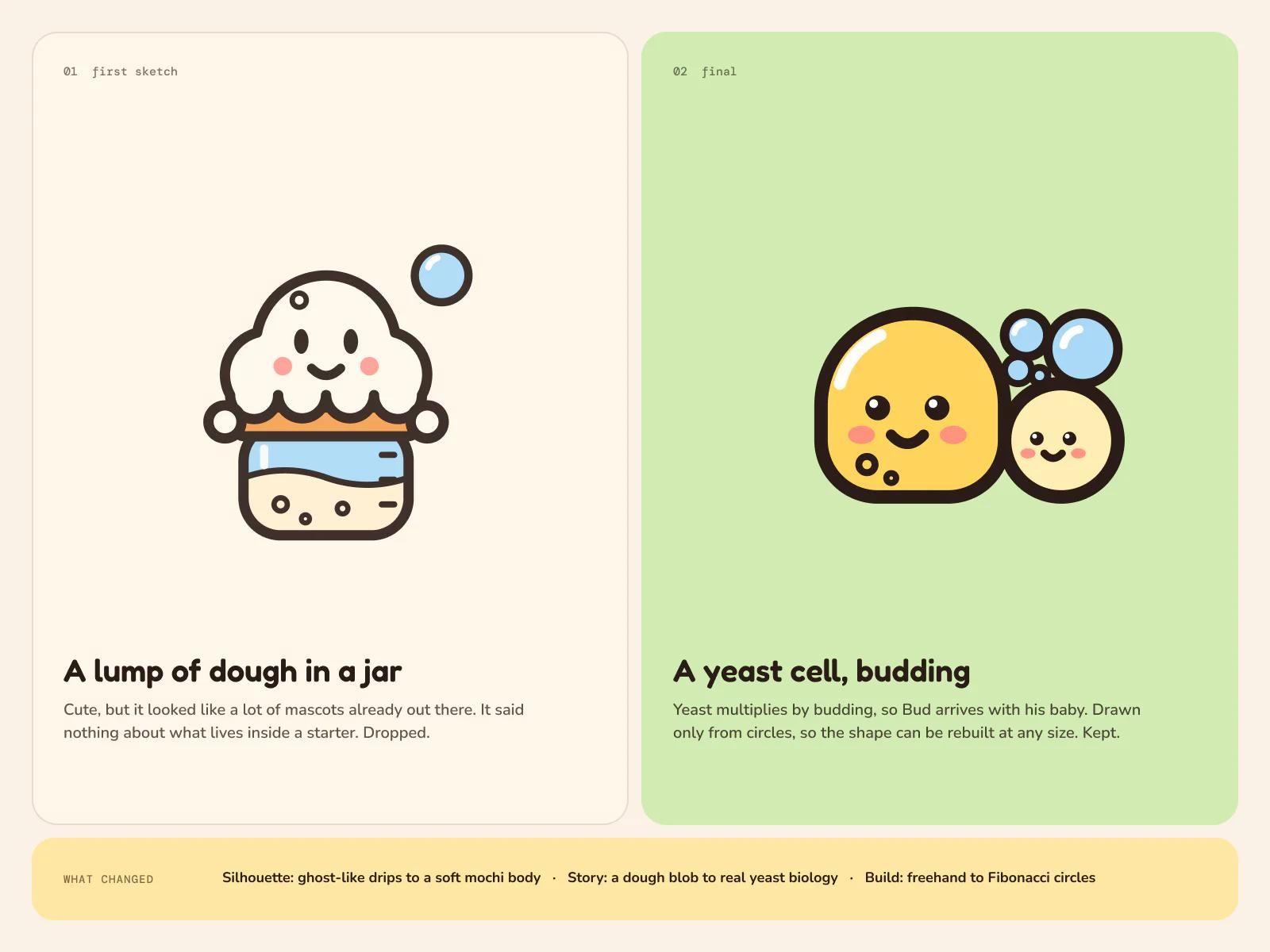
First sketch next to the final: a lump of dough in a jar, dropped, and a budding yeast cell, kept
Process board: a yeast cell, a bud forming, the bud growing and Bud; the name going from levain to levvy; the rising wordmark baselines

06

How was Bud constructed?

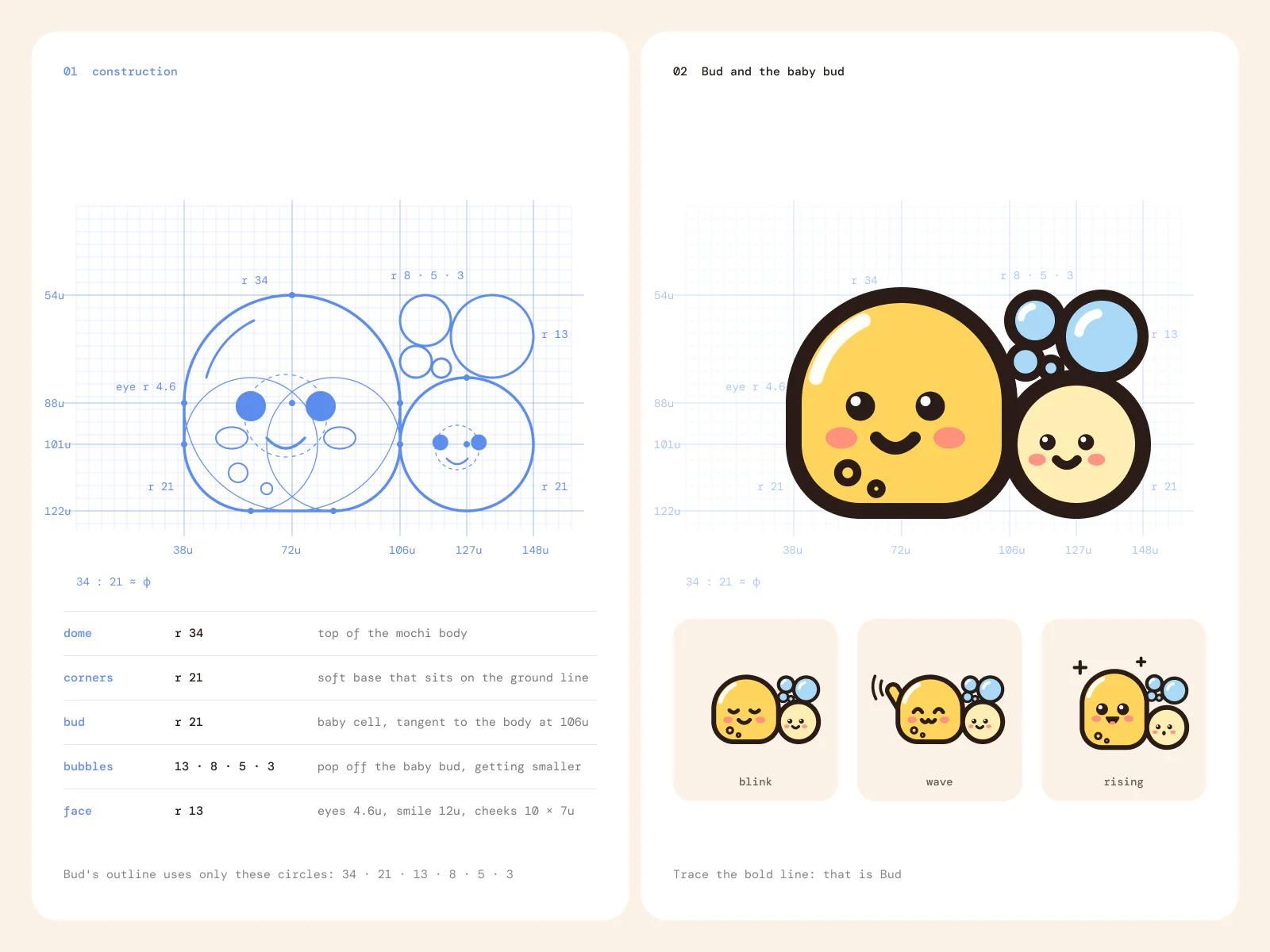
Bud is drawn only from circles, and the circles follow the Fibonacci sequence:

  • Body: a dome of radius 34 with two corner arcs of radius 21, sitting on a flat base.
  • Baby bud: a circle of radius 21, touching the body.
  • Bubbles: radii 13, 8, 5 and 3, getting smaller as they rise.
  • Face: eyes of radius 4.6 inside a face circle of radius 13.

34 to 21 is close to the golden ratio, so the parent and the baby feel balanced without being equal. The construction tile shows the working: the grid, the guides, every circle and tangent point, and then Bud's outline drawn over them in a bold line. If you only see the circles, you can still read the character.

We drew him in four steps:
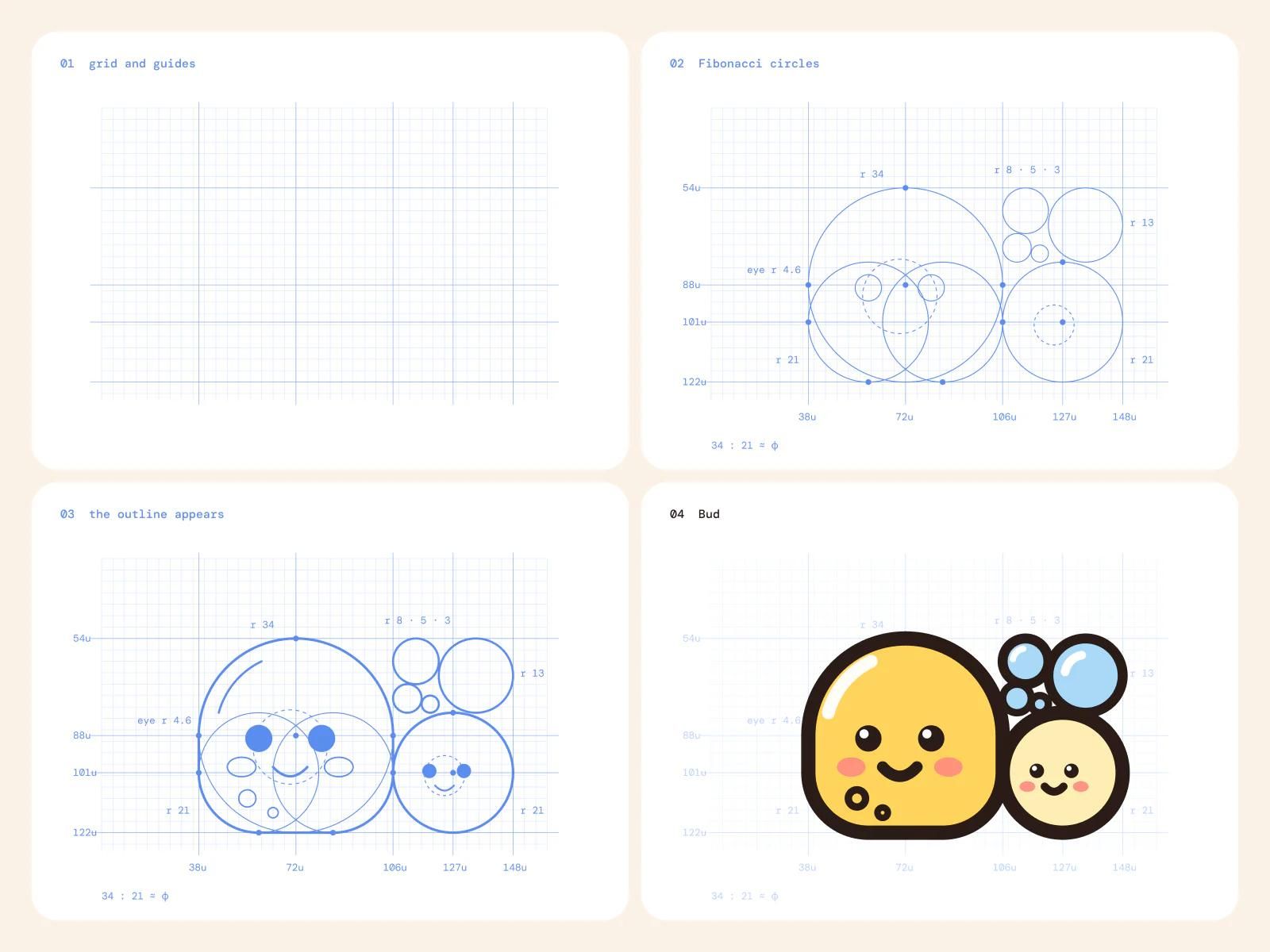
  1. Grid and guides. A 4-unit grid with guides at the top of the dome, its centre, the base of the corners and the ground line.
  2. Fibonacci circles. The dome, the two corners, the baby bud, the four bubbles and the face circle, with every tangent point marked.
  3. The outline appears. One bold line traces the parts of the circles that belong to Bud. Nothing else is drawn by hand.
  4. Bud. Fill, face, shine and the two small bud scars on his body.
Four construction steps: grid and guides, Fibonacci circles, the outline appearing, and the finished Bud
Construction board: every circle and radius on the left, Bud drawn over the same grid on the right

07

What does the logo system include?

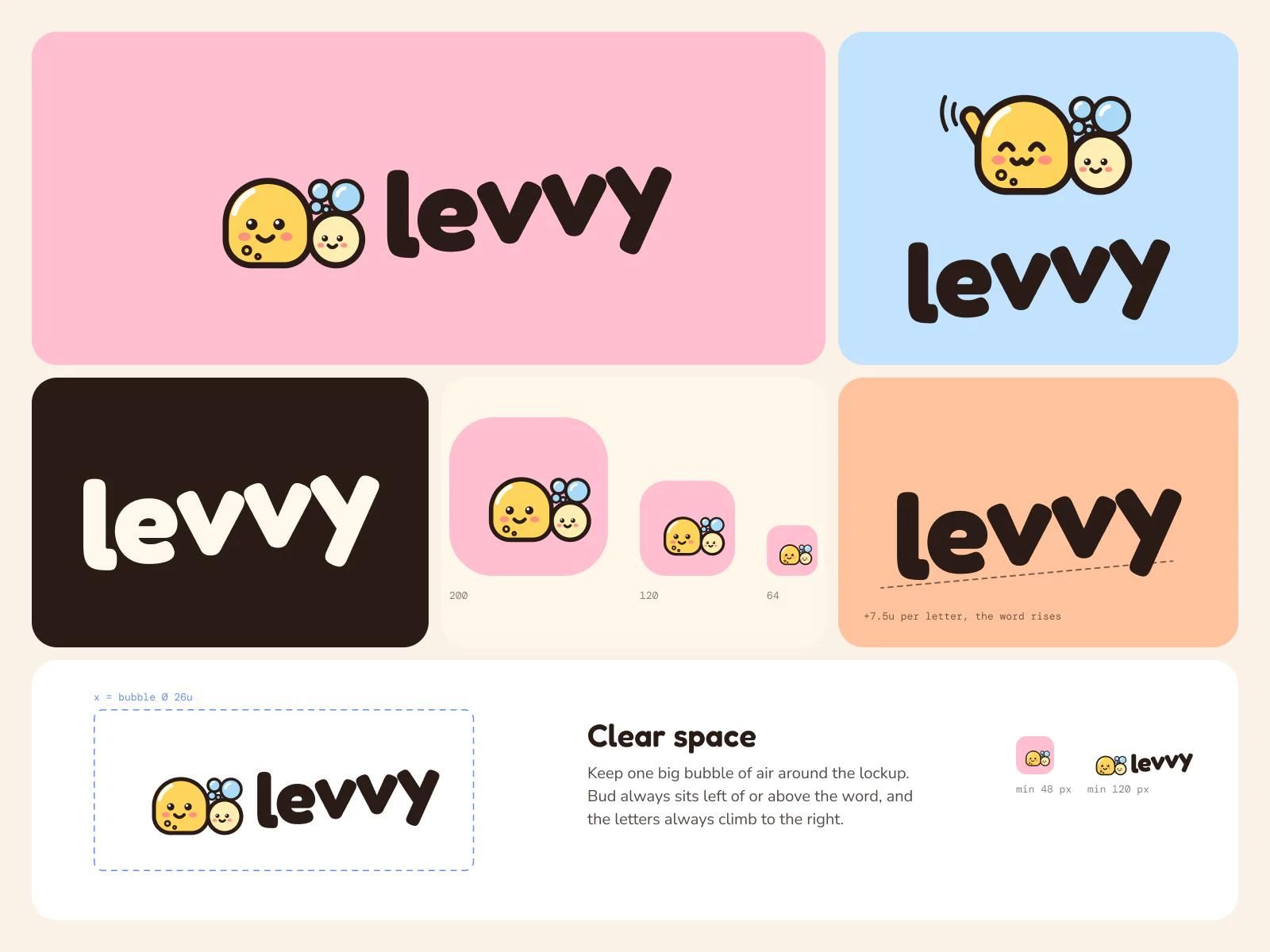
  • Wordmark: "levvy" set in a rounded bold face, with each letter sitting 7.5 units higher than the one before it. The word rises, the way dough does.
  • Lockups: a horizontal lockup (Bud beside the word) and a stacked one (Bud above the word).
  • Icon mark: Bud and his baby inside a strawberry-milk pink square, readable down to 48 px.
  • Lockup variants: Bud perched on top of the two highest letters, a round club badge, the app icon on a home screen, and a repeat pattern that alternates the word with Bud's expressions.
  • Rules: keep one large bubble of clear space around the lockup, keep Bud left of or above the word, and keep the letters climbing to the right. Minimum sizes are 48 px for the icon and 120 px for the horizontal lockup.
Logo system: horizontal and stacked lockups, wordmark on cocoa, icon mark at three sizes and the clear space rule

08

What colours and type does the brand use?

Eight soft, sweet colours, named after what goes into a morning kitchen. Bud keeps his own butter yellow; the rest of the palette stays light so he always stands out.

NameHexRole
Oat Milk#FFF6EApaper
Cocoa#2A1C17ink
Butter#FFD45CBud
Custard#FFE7A3soft highlight, buttons
Apricot#FFC39Ewarmth, jar rim
Strawberry Milk#FFBFD0cheer, app icon
Pistachio#D3EBB4fed, success
Baby Blue#C2E2FFjar glass, calm

Type is a three-part system: Fredoka for display and the wordmark, Nunito for interface text, and DM Mono for labels, units and data such as feed times and rise percentages.
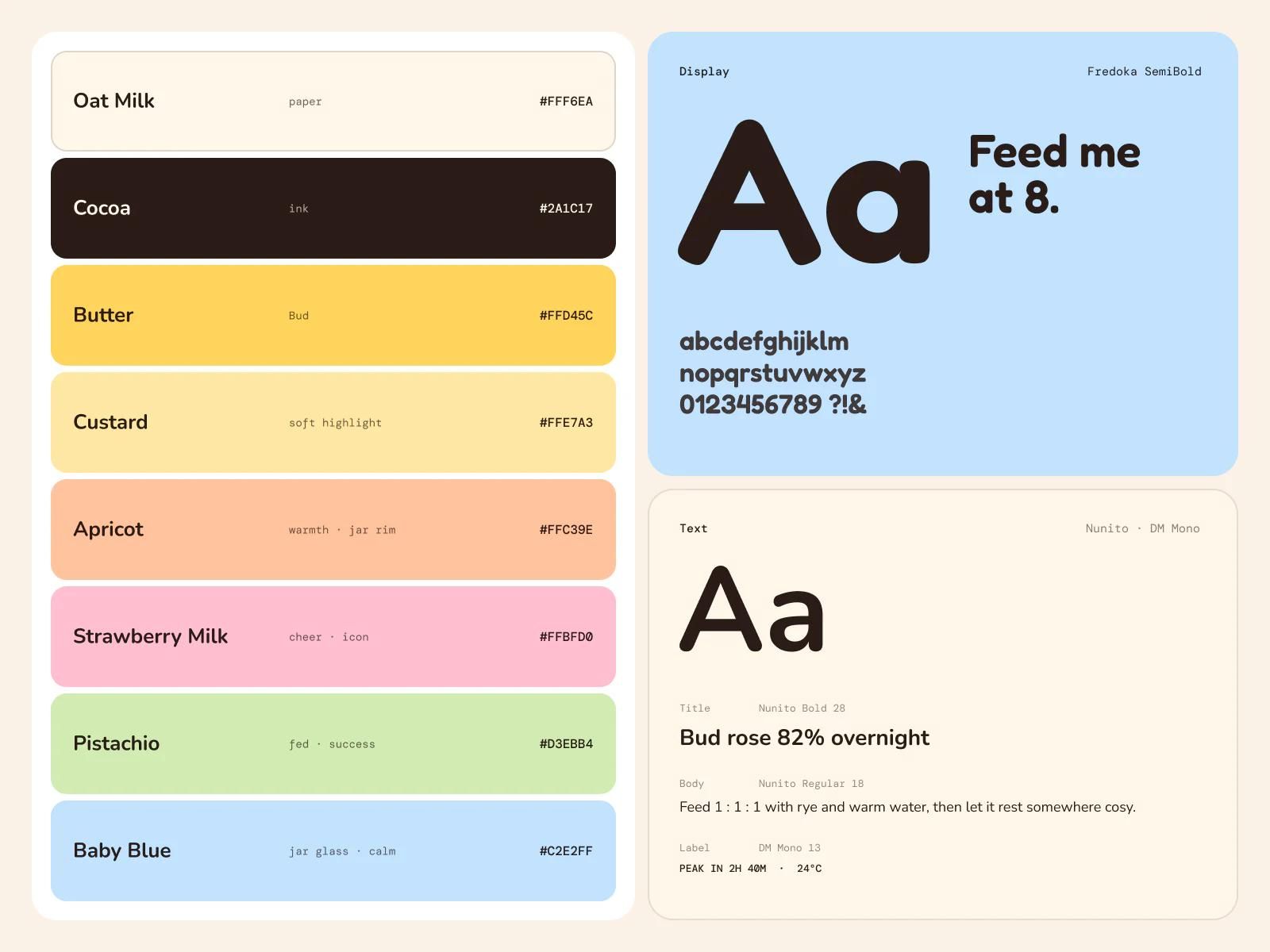
Palette of eight soft named colours with hex values, and the Fredoka, Nunito and DM Mono type specimens

09

How does Bud show what the starter is doing?

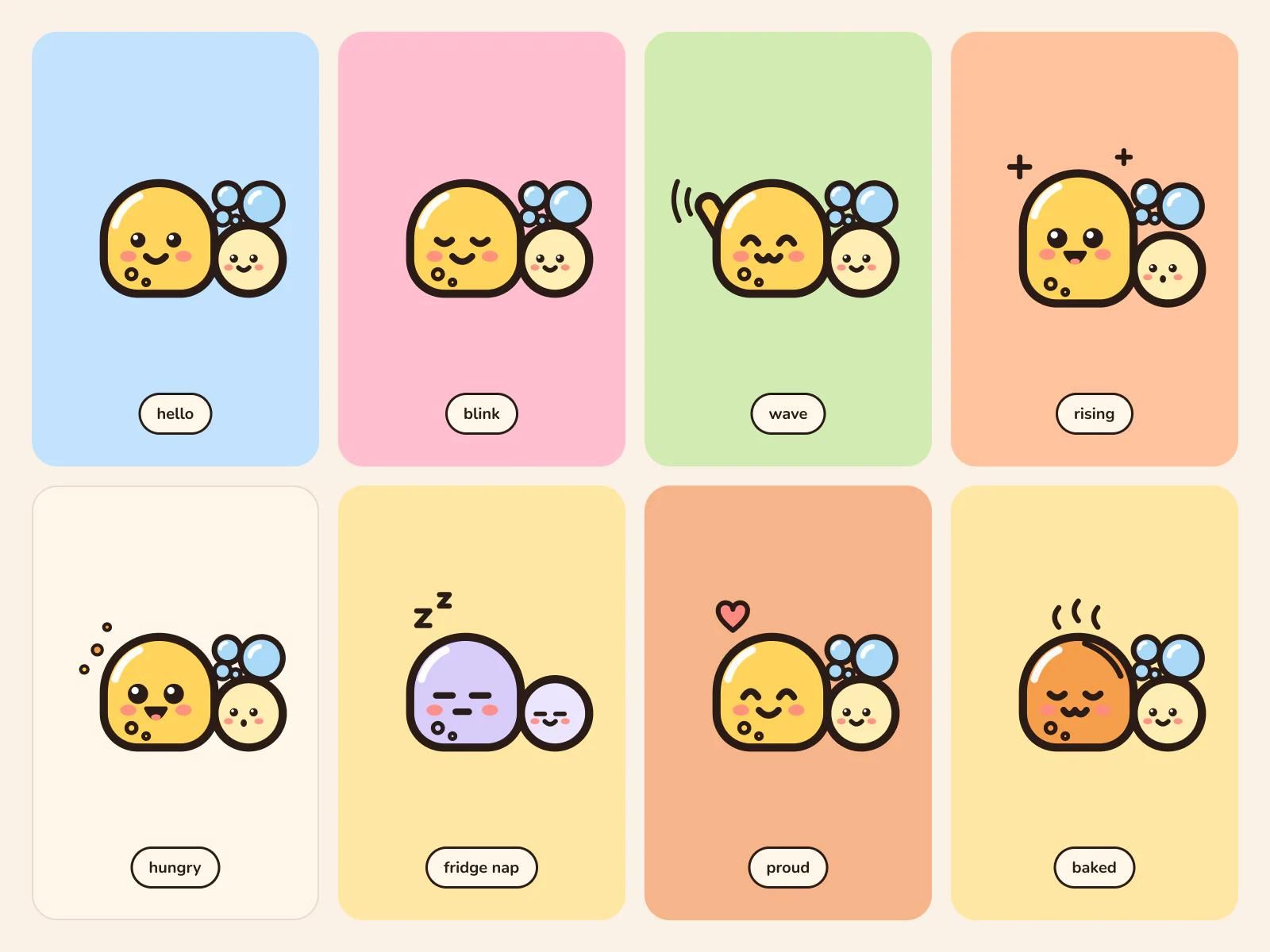
Bud has eight expressions, and each one maps to a real state of a starter:

  • Hello and blink: the default, a healthy starter.
  • Wave: onboarding and greetings.
  • Rising: the starter is growing after a feed.
  • Hungry: it is time to feed.
  • Fridge nap: the starter is resting in the fridge, a common way to slow it down between bakes.
  • Proud: it peaked on schedule.
  • Baked: the bread is out of the oven.

Because the states come from baking, the stickers work both as product UI and as social content.
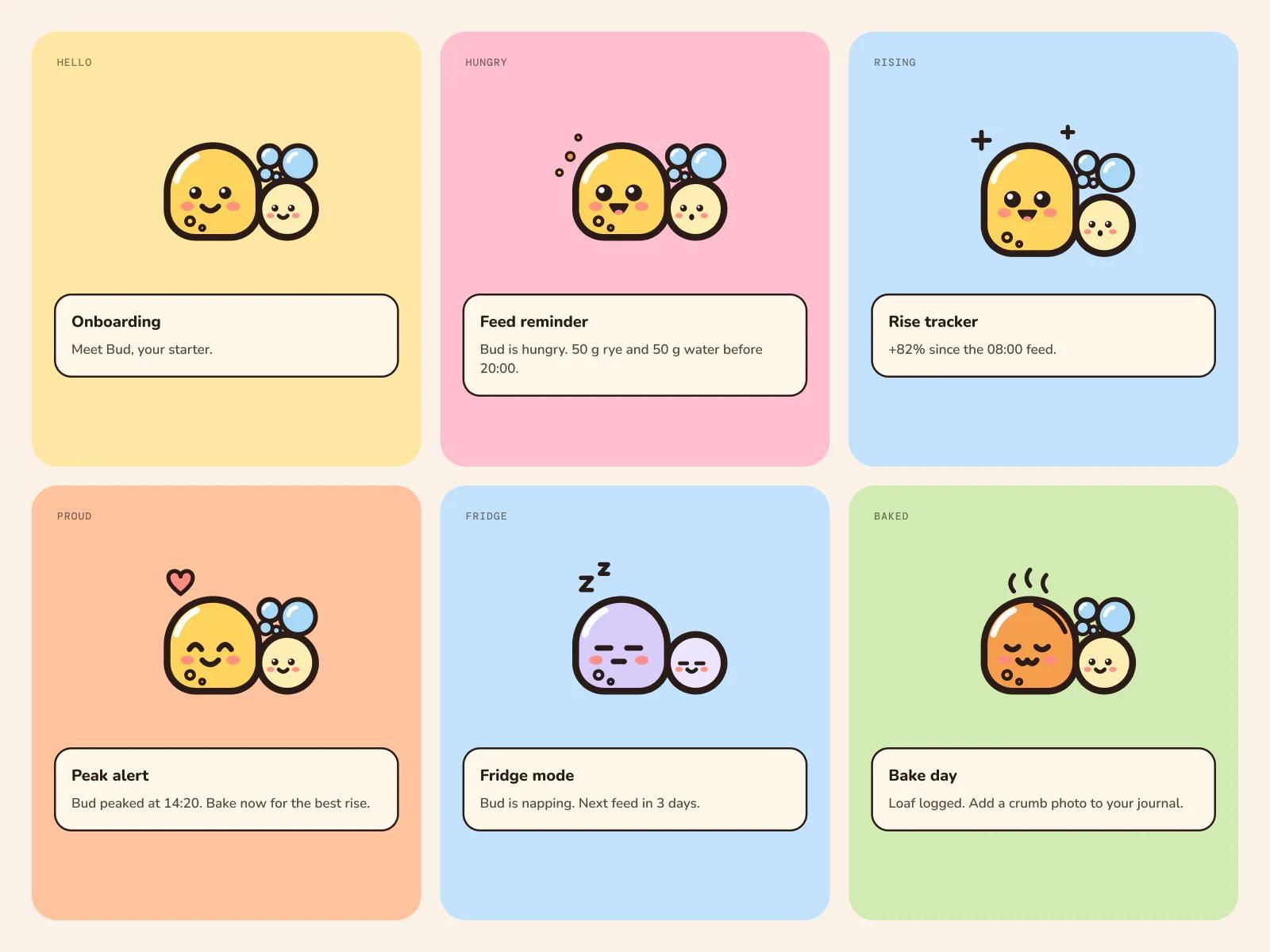
Six expressions in use: onboarding, feed reminder, rise tracker, peak alert, fridge mode and bake day
Eight Bud stickers: hello, blink, wave, rising, hungry, fridge nap, proud and baked

10

What do the app screens do?

We designed three onboarding screens around things only a sourdough app would need:

  1. Meet Bud. Bud sits inside a glass jar with a rubber band around it. Bakers really do this: the band marks where the starter started, so you can see how far it has risen.
  2. Feeding rhythm. A 24-hour dial with a sun handle for the morning feed and a moon handle for the evening feed, a 1 : 1 : 1 feed ratio (50 g starter, 50 g rye flour, 50 g water) and a choice of flour.
  3. Rise tracker. The starter has risen 82% since the 08:00 feed. The jar shows the level against the band, and a day timeline marks the last feed, now, the expected peak and the next feed.

Buttons are thick-outlined with a hard offset shadow, so they feel like pressable stickers rather than flat rectangles.
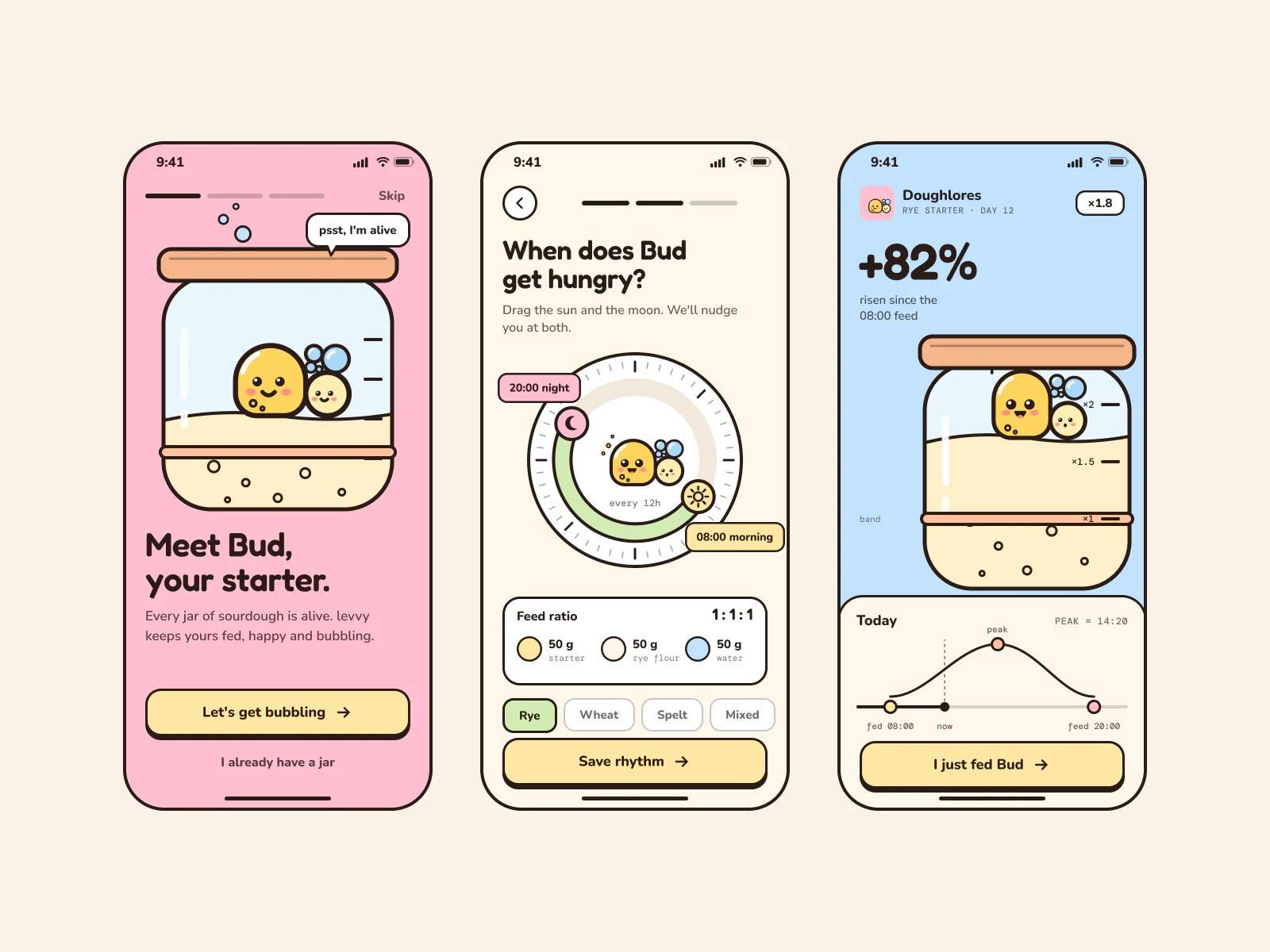
Three app screens: Meet Bud in a jar with a rubber band, the 24-hour feeding dial, and the rise tracker at +82%

11

What does the brand look like off-screen?

We put levvy where its users actually live: a linen apron on a home baker in her kitchen, the app open on a phone in her hand, a baby blue enamel mug held with both hands, die-cut Bud stickers on a laptop, and a canvas tote at a weekend farmers market.
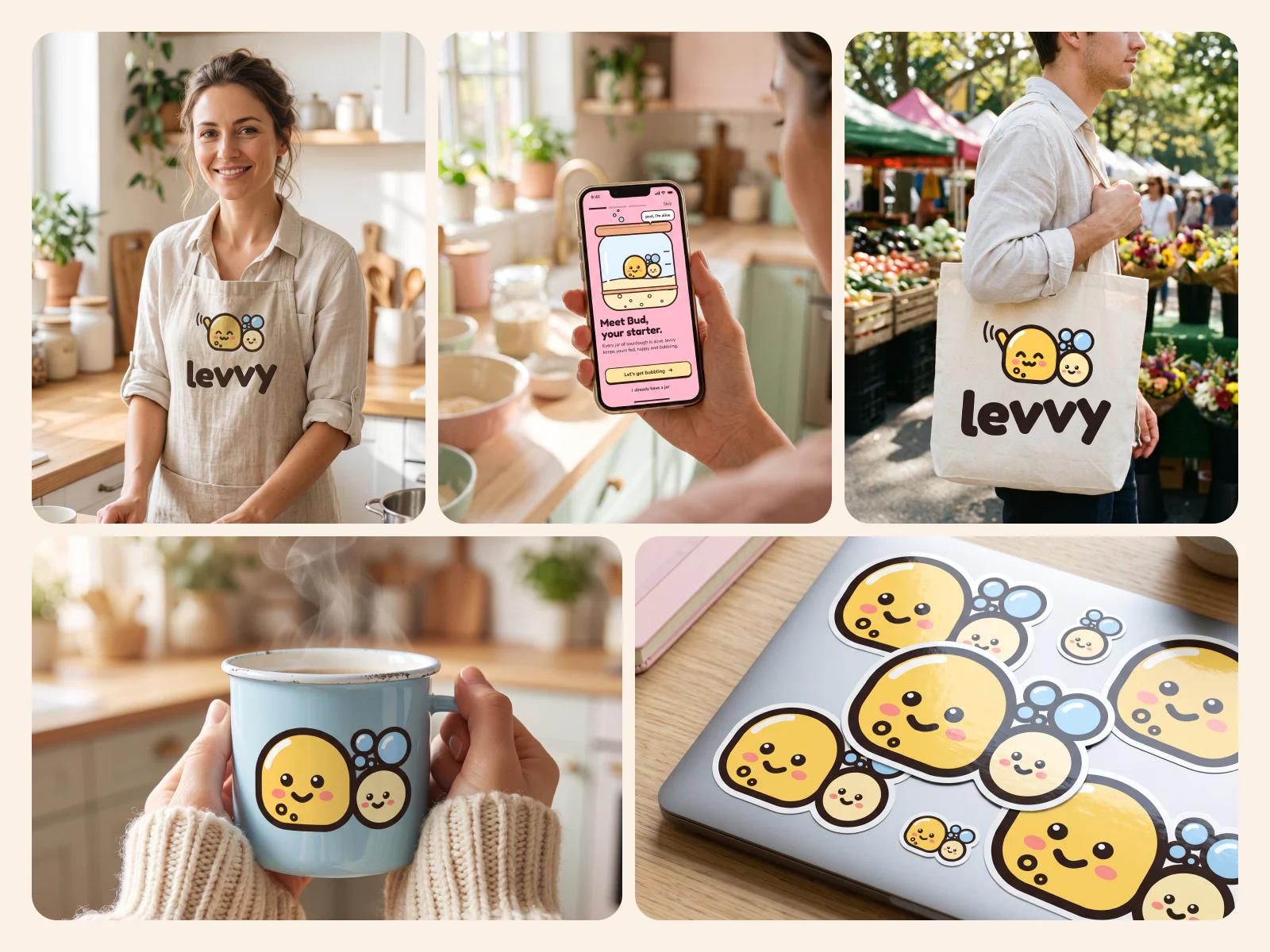
levvy on a linen apron, a phone in hand, a tote at a market, a baby blue mug and laptop stickers

12

How does the brand move?

Motion is part of the identity, not something added at the end, and it follows how a starter behaves. Nothing slides or fades in. Things rise.

  • Rising, not sliding. The letters of the wordmark grow up out of the baseline one by one, the way dough comes up in a jar, and settle back down at the end of the loop.
  • Budding. Bud never just appears. His baby bud swells first, then the parent cell inflates from the ground line with a small squash as he lands.
  • Breathing. At rest Bud slowly inflates and deflates like proofing dough, and now and then a bubble leaves his head, rises and pops.
  • The construction fills like a jar. The grid rises from the ground line, every circle draws from its lowest point, the outline traces Bud, and then the colour fills him from the bottom with a soft wavy surface, like a starter climbing the glass. At the end it drains back down.
  • Screens change by rising. In the app tile each new screen comes up from the bottom of the phone with the same wavy surface instead of a sideways push.
  • Product moments. A "today" marker walks along the feeding week and each day's Bud acts out its state: hungry shakes, rising stretches, fridge nap shivers. The app icon gets pressed and Bud springs up. A yeast cell buds, grows and turns into Bud.
  • Close-ups. Once Bud is filled, the camera moves in on his face, then on the baby bud, and pulls back out before the drain.
  • One entrance. Every tile on a board arrives at the same moment and leaves at the same moment, so the loop reads as one piece.
  • Product moments as tiles. A lock-screen notification drops in ("Bud is hungry"), a home-screen widget fills its rise ring, the feeding dial swings its sun and moon handles, and a strip of Bud's states takes turns: smile, hungry, rising, proud, sleepy, baked.

We built four 1600 × 1200 boards, each a seamless 16-second loop: Daylight, Kitchen, Candy and Lockups. Every movement repeats on the same 8-second clock, so the loops close without a jump. The sound is a soft music bed with a few quiet accents: a shimmer as the drawing starts, a round bubble as the starter fills Bud, and a soft swell as it drains.
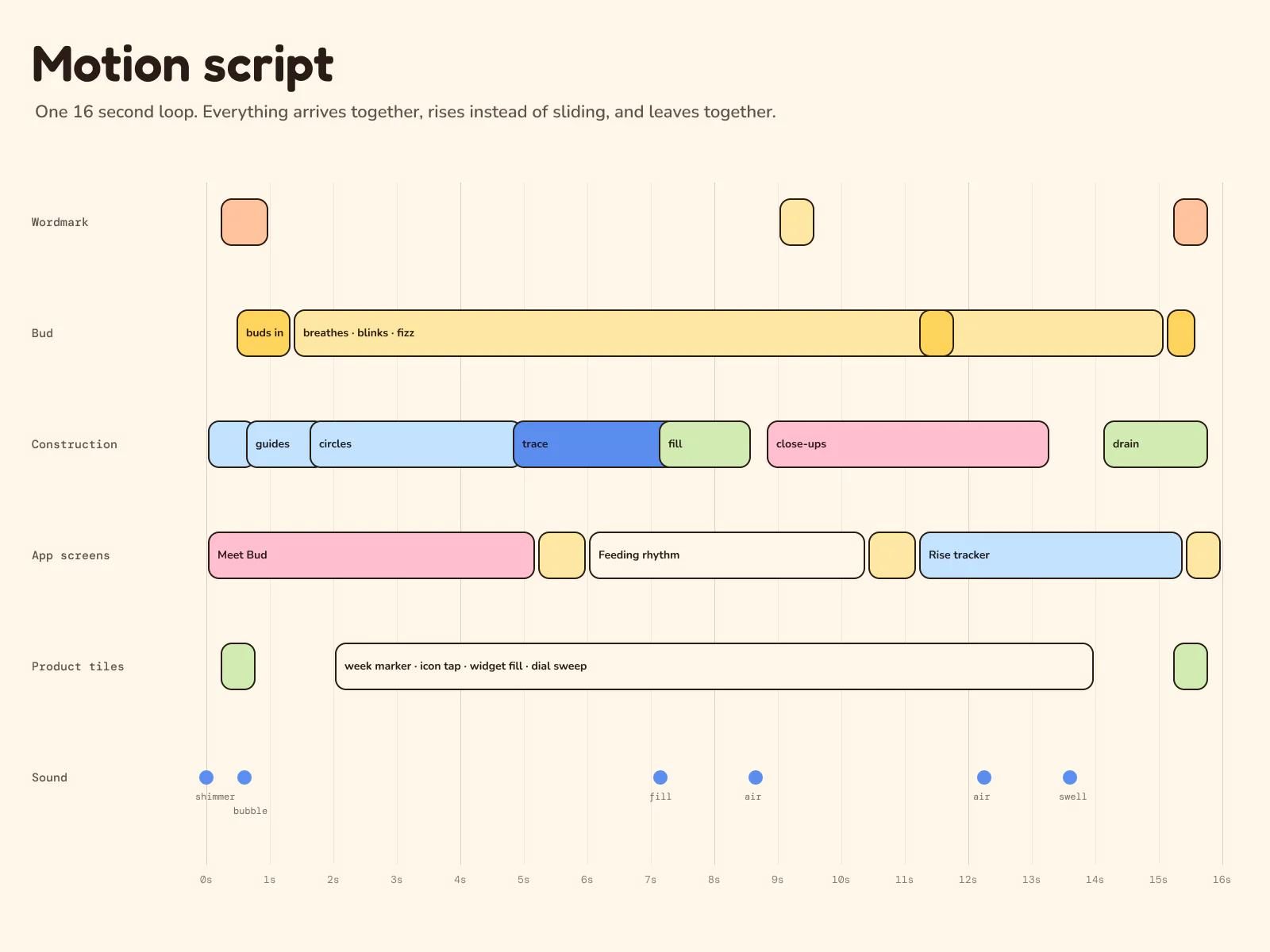
Motion script: a 16 second timeline with lanes for the wordmark, Bud, the construction, the app screens, the product tiles and sound

13

How did the project come together?

Eight steps, in order: study the biology, name it, find the character, construct it from circles, build the logo system, set colour and type, design the product, then put it into the world and into motion.
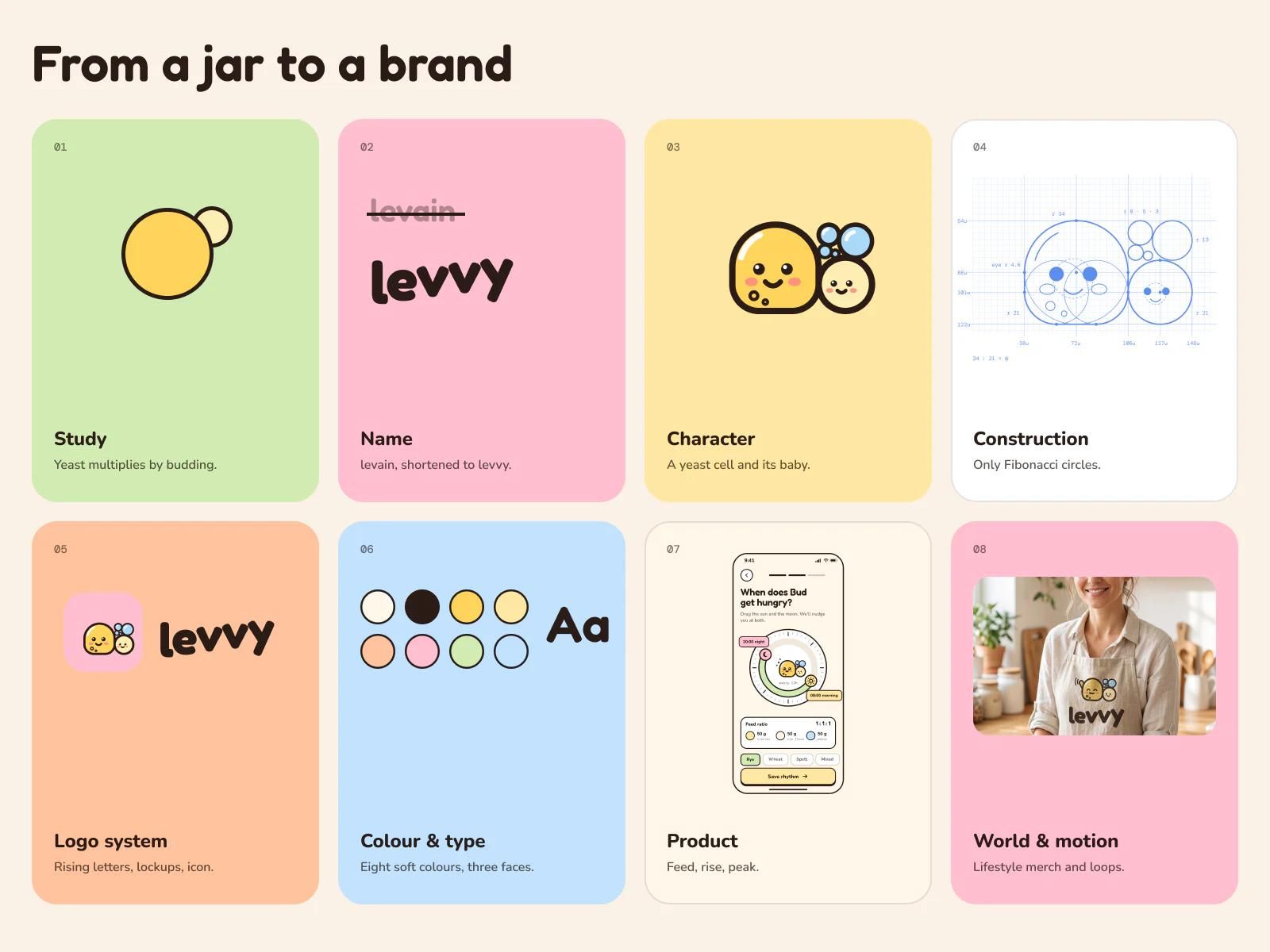
Process overview: study, name, character, construction, logo system, colour and type, product, world and motion

14

What we delivered

  • Name, idea and brand story
  • Mascot design and construction drawing
  • Wordmark, lockups, icon mark and four pose variants
  • Colour palette and type system
  • Eight mascot expressions
  • Three app onboarding screens
  • Five lifestyle merch mockups
  • Three bento brand boards and a lockup board
  • Four 16-second motion loops, silent and with sound

Questions

About this project.

Is levvy a real product?

No. levvy is a self-initiated concept by Urest. We made it to show how we build a mascot-led identity from the first idea to motion. There is no app to download.

Why is the mascot a yeast cell?

A sourdough starter is a colony of wild yeast and bacteria, and yeast reproduces by budding. Drawing Bud as a yeast cell with a baby bud gives the brand a character that comes from the product itself, not from a generic cute-mascot template.

How is the mascot built?

Bud is drawn only from circles with Fibonacci radii: a 34-unit dome, 21-unit corners and baby bud, and 13, 8, 5 and 3-unit bubbles. The construction tile shows every circle, so the shape can be redrawn precisely at any size.

What did the identity include?

The name, the mascot and its construction, a rising wordmark, lockups and an icon mark, an eight-colour palette, a three-face type system, eight expressions, three app screens, five lifestyle merch mockups, and four looping motion boards with sound.

Process

How the project went.

  1. 01

    Study

    Study the biology.

  2. 02

    Name

    Name it.

  3. 03

    Character

    Find the character.

  4. 04

    Construction

    Construct it from circles.

  5. 05

    Logo system

    Build the logo system.

  6. 06

    Colour and type

    Set colour and type.

  7. 07

    Product

    Design the product.

  8. 08

    World and motion

    Put it into the world and into motion.

Tell us what you are building.

A 30-minute call. We will look at where you are, what is not working, and what we would do about it. No deck, no pitch.