




When You Actually Need Custom Website Development (And When You Don't)
Most companies that think they need custom development don't. Some that think no-code will stretch far enough are wrong. Here's how to tell which one you are.
 Written byMatt Gemi, Founder, Urest
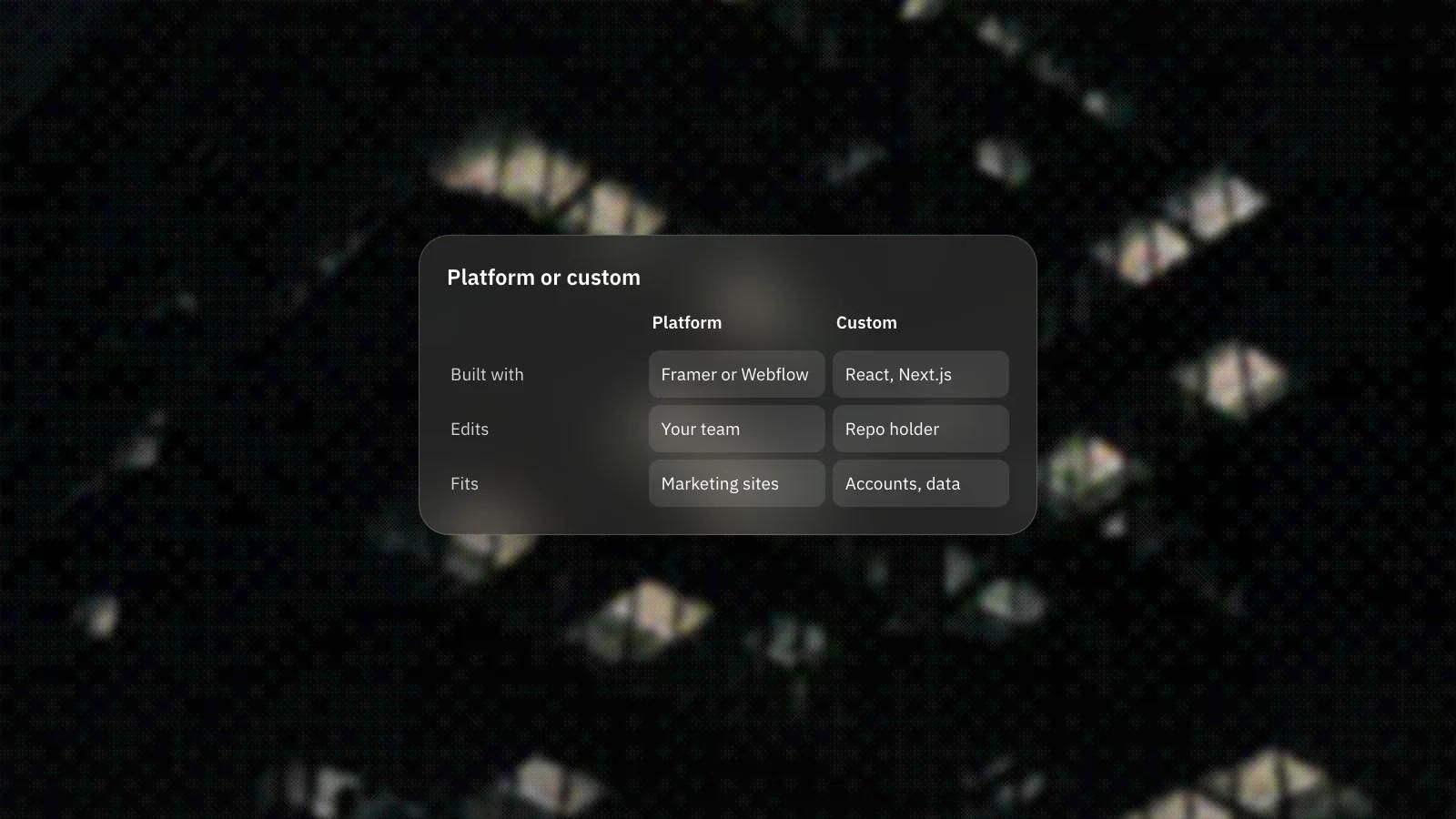
You need custom website development when your site has to do something a platform cannot do: real user accounts, a database you own, server-side business logic, or integrations that go deeper than an embed. If your site's job is to explain what you sell and get people to contact you, a no-code platform like Framer or Webflow will do it faster, cheaper, and with less ongoing maintenance. The mistake isn't picking one or the other. It's picking before you've written down what the site actually has to do.
We build on both. We're a certified Framer studio, we build in Webflow, and we write React, Next.js and Node when a project calls for it. That means we have no reason to talk you into the expensive option. This is the framework we use internally, written out.
What counts as custom website development?
Custom website development means the front end and usually the back end are written in code your team owns: typically React or Next.js on the front, Node or similar behind it, running on infrastructure you control. Nothing is constrained by what a visual editor exposes.
That's the real distinction, and it isn't about quality. A Framer site can be faster, better designed, and better optimised than a badly built custom one. The distinction is about ceiling and ownership. Custom code has no functional ceiling and no vendor between you and your users. It also has no safety rails, no free hosting, and no one else maintaining the platform underneath you. You're taking on the ceiling and the burden together.
Bespoke web development is the same thing under a different name. Some agencies use it to imply a higher tier of craft. It doesn't mean anything more than "written from scratch."
When is custom development actually warranted?
Custom is warranted when a platform would block something the business depends on. Not something on the roadmap. Something the site has to do for the business to work.
Concrete signals, in rough order of how often they turn out to be real:
- Authenticated users with real state. Logins, dashboards, saved data, permissions. The moment a user has an account that holds anything, you need a back end.
- Your data is the product. Property portals, course catalogues, marketplaces: thousands of records with filtering, sorting, and search that users treat as a tool rather than a page. Platform CMSs handle content. They don't handle a database with query logic on top.
- Integrations that write, not just read. Pulling a feed in is easy anywhere. Two-way sync with a CRM, a booking system, or a property management platform (where the site changes records in another system) needs a server.
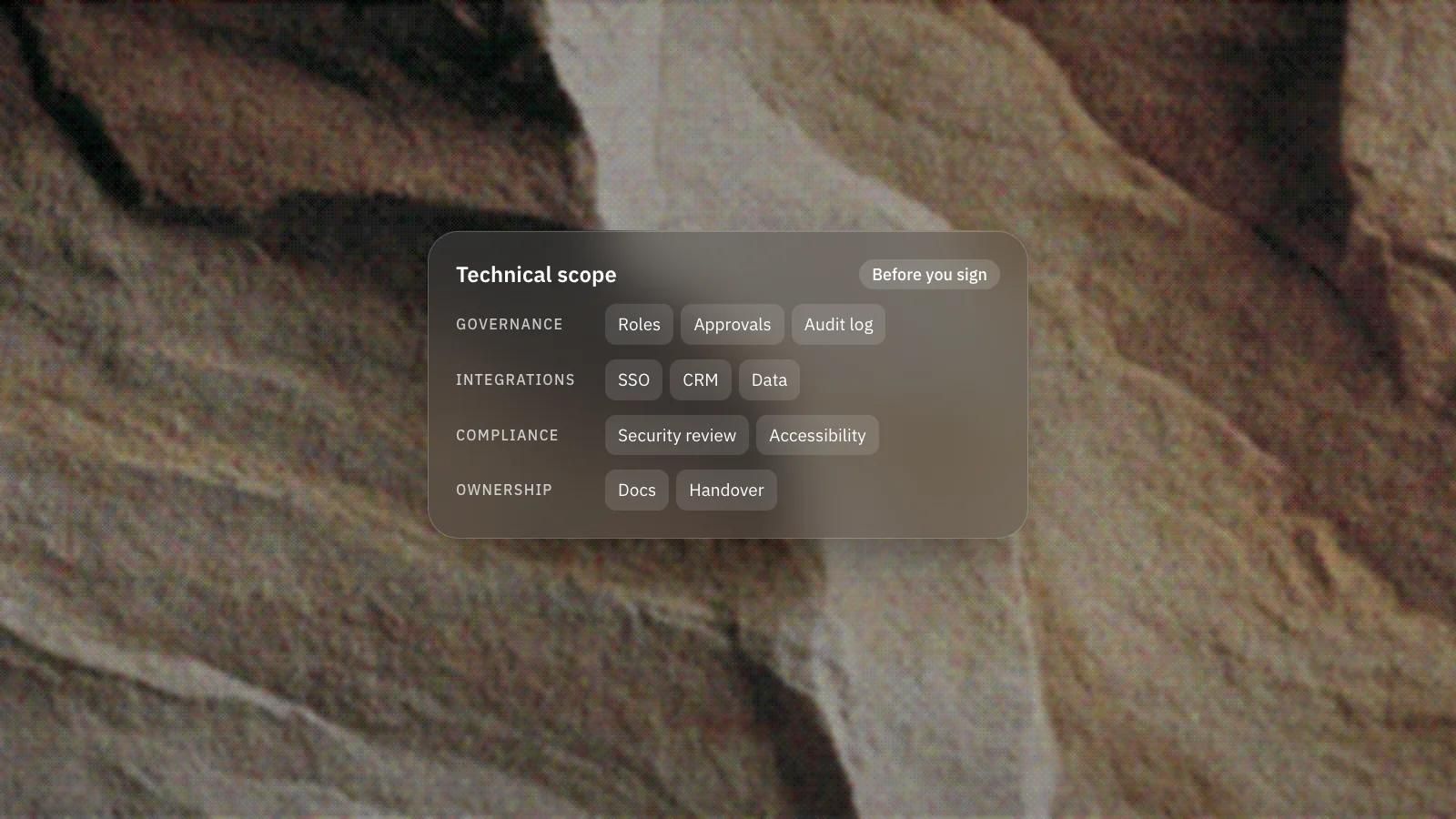
- Compliance or data residency requirements you must prove. If a client contract or regulator dictates where data lives and who can touch it, you need to control the stack.
- The site is really an application. Some projects need custom logic, complex integrations, or a real product rather than a marketing site. If yours is one of them, you'll usually know because describing the site takes longer than describing the company.
One signal is enough. If you can't point to any of them, custom development is buying capability you won't use.
Why do most companies overestimate what they need?
Because "custom" sounds like a quality decision and it's really a constraints decision. Teams conflate "we want this to look distinctive" with "we need this built from scratch," and those haven't been the same thing for years.
The overspend rarely shows up on day one. It shows up in month seven, when marketing wants to change a headline and has to file a ticket. A no-code build hands editing rights to the people who actually own the content. A custom build hands it to whoever holds the repository. If that's an agency you're paying hourly, every copy tweak has a price and a queue.
Then there's what a custom site quietly commits you to: dependency updates, security patches, hosting, monitoring, and a person who understands the codebase and is still reachable in two years. Platforms absorb all of that. That's most of what you're paying them for.
The test we use: if a website is mainly pages, content, forms and tracking (even a lot of them, even with unusual design), a platform will carry it. Design ambition is not a reason to write code. Framer and Webflow will render nearly anything a designer draws.
When does no-code stop being enough?
No-code stops being enough at the point where you start building workarounds. That's the tell, and it's more reliable than any feature checklist.
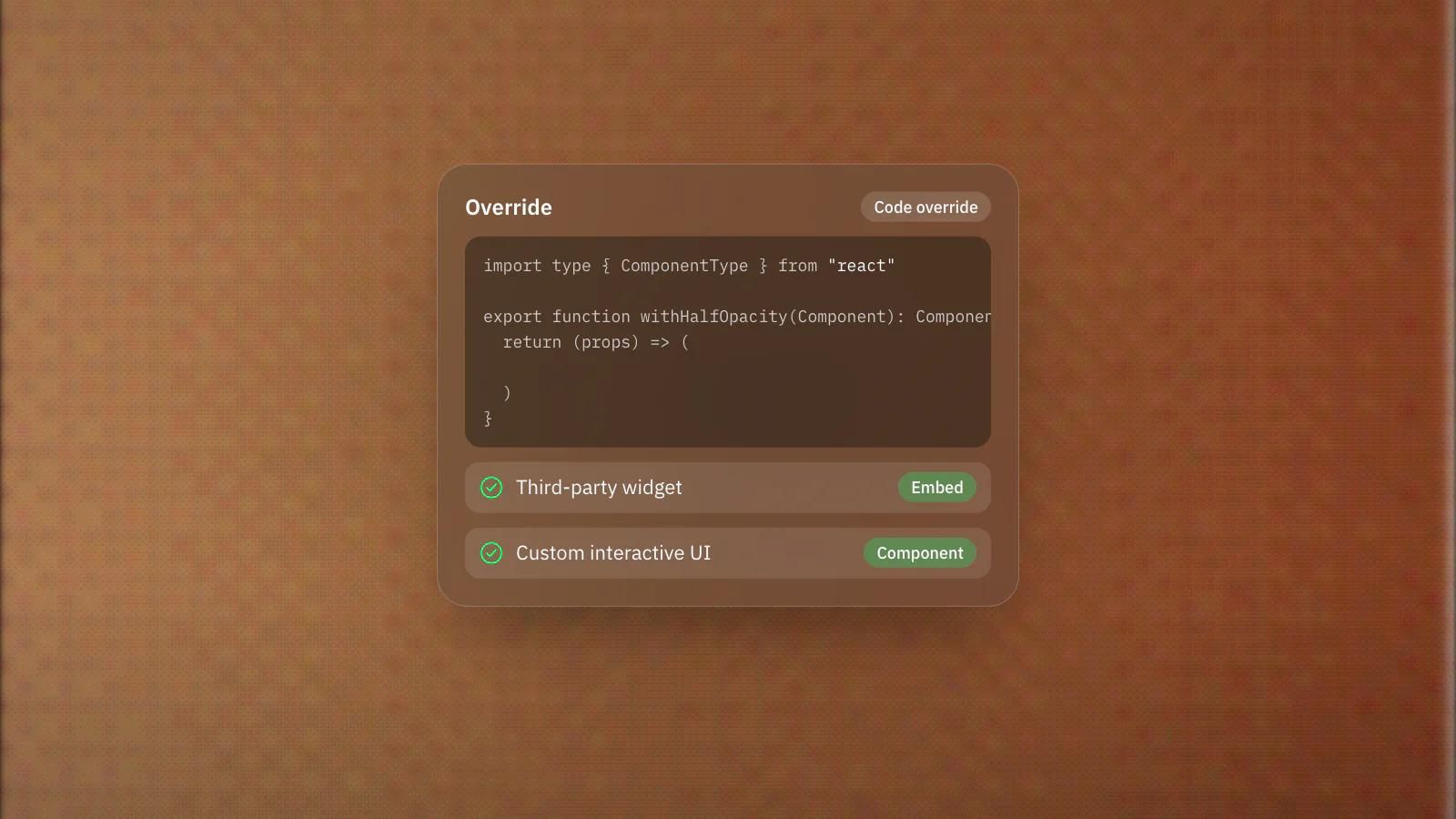
The failure mode here is subtler than overbuilding, and more expensive to fix. It looks like this: a team picks a platform correctly, grows, and then starts bolting on third-party widgets, embedded tools and duct-taped automations to reach behaviour the platform doesn't natively support. Each patch works. Together they become a system nobody designed, hosted across four vendors, that breaks in ways no single support team can diagnose.
Signs you've passed the line:
- Core functionality lives in embedded third-party tools rather than the site.
- You're syncing data between platforms manually or with automations that fail silently.
- Page load has degraded because of accumulated scripts.
- Someone maintains a spreadsheet to keep the site accurate.
- A feature the business needs has been deferred twice because "the platform can't do it."
Migrating later is normal and fine. Migrating after three years of accumulated workarounds is a rebuild. It's cheaper to notice early.
What about AI-generated MVPs?
AI builders like v0, Lovable and Bolt are genuinely good at getting something real on screen quickly. They are not good at producing code you can safely run a business on, and the gap isn't obvious from the outside.
What we see when we're asked to rebuild these: no meaningful test coverage, authentication implemented approximately, secrets in places they shouldn't be, database queries that are fine at ten users and fall over at a thousand, and dependency choices nobody chose deliberately. It works. It demos well. It hasn't been engineered.
Use them for exactly what they're good for: proving the idea, showing a stakeholder, getting a first user. Then rebuild the parts that will carry real traffic and real data before they do. Taking an AI-generated MVP into production-grade code is a specific piece of work, and it's much easier done at month two than month twelve.
How should you actually make the call?
Write down what the site must do, in plain sentences, before anyone discusses stack. Then check each requirement against what a platform can do natively. Natively, not via a plugin or an embed.
If everything clears, use the platform. If two or three things don't, look at whether those things are central or peripheral; peripheral gaps can often live in a separate tool without contaminating the main site. If something central doesn't clear, you need custom development for that part, and possibly only that part. A marketing site in Framer with a custom-built application on a subdomain is a completely legitimate architecture, and often the cheapest correct answer.
Then ask the question most agencies skip: who maintains this in two years? A stack the client's team can't operate is a bad stack regardless of how good it is on paper. We choose the stack that fits the requirements and the team's ability to maintain it, not just what's trendy. Numbers matter more than adjectives here: cost of ownership, time to publish a change, number of people who can make one.
A website's job is to work, not just to look finished. Both routes can get you there. Only one of them is right for your situation, and it's usually quick to decide if you're honest about the requirements.
Frequently asked questions
Is custom website development worth the cost for a small business?
Usually not, if the site's job is marketing: explaining the offer, building trust, and capturing enquiries. A no-code platform like Framer or Webflow covers that at a fraction of the cost, with hosting and maintenance included and content editable by non-developers. Custom development becomes worth it for a small business when the site needs user accounts, a proprietary database, or deep two-way integrations with other systems.
What is the difference between bespoke web development and using a website builder?
Bespoke web development means the site is written from scratch in code (typically React or Next.js with a Node back end), so there is no functional ceiling and you own the codebase outright. A website builder gives you a visual editor on top of a managed platform: much faster to build and maintain, but limited to what the platform supports natively. The tradeoff is capability and ownership versus speed, cost, and reduced maintenance burden.
Can you migrate from Framer or Webflow to custom code later?
Yes, and it's a common and reasonable path: build fast on a platform, migrate the parts that outgrow it. Migration is straightforward when it happens early, because content and design translate cleanly. It gets expensive when a site has spent years accumulating third-party embeds and workarounds, because at that point you're untangling a system rather than porting one.
Do custom-built websites perform better in search than no-code sites?
Not inherently. Google evaluates the rendered page (content, structure, speed, mobile experience), not the tool that produced it. Modern platforms like Framer and Webflow output clean, fast, crawlable pages and handle technical SEO fundamentals well. Custom development gives you finer control over things like programmatic page generation at scale or unusual rendering requirements, which matters for some sites and is irrelevant to most.